AWS re:Invent – 4 takeaways from the biggest cloud event of 2022

This year’s AWS re:Invent was a resounding success. The 11th event to be held in just over 10 years, it was attended by over 50,000 customers and partners in Las Vegas—with an additional 300,000 registered attendees watching online!

It was billed as the “most transformative event in tech” and it absolutely delivered. Starting with a fantastic opening keynote from Amazon Web Services (AWS) CEO Adam Selipsky, which truly set the bar for the rest of the experience.

Of course, not everyone would have been able to attend or watch online. Which is why we’ve taken the time to put together our four main takeaways from AWS re:Invent keynotes of 2022, starting with Selipsky’s opening speech below.

Four takeaways from AWS re:Invent 2022

1. Now, that's how you do an opening keynote!

Before we start deep-diving into some of the insights from AWS re:Invent 2022, we wanted to take a moment to talk about Selipsky’s opening keynote.

Not only did this set the bar for what was to come, but it also highlighted how the success of re:Invent (and nearly half-a-million people watching) is “small fry” compared to the wins that businesses using AWS are experiencing. Selipsky noted that, “BMW Group is revolutionizing the driving experience with its Connected Car platform”, that Riot Games “is now processing roughly half a million events per second” through AWS. What’s more:

In his opening speech, Selipsky also highlighted the many innovations that businesses are delivering to create a better future with AWS, in areas like data, security, specialized solutions, and infrastructure.

He then spoke on the launch of new tools and functionalities in AWS, such as Amazon OpenSearch Serverless, Amazon Aurora zero-ETL integration with Amazon Redshift, Amazon Redshift integration for Apache Spark, Amazon DataZone, ML-powered forecasting with Q, Amazon Security Lake, AWS SimSpace Weaver, and much more.

Want to watch one of the most exciting opening keynotes in cloud computing?

#2 The role of data and digital in the transition to renewables

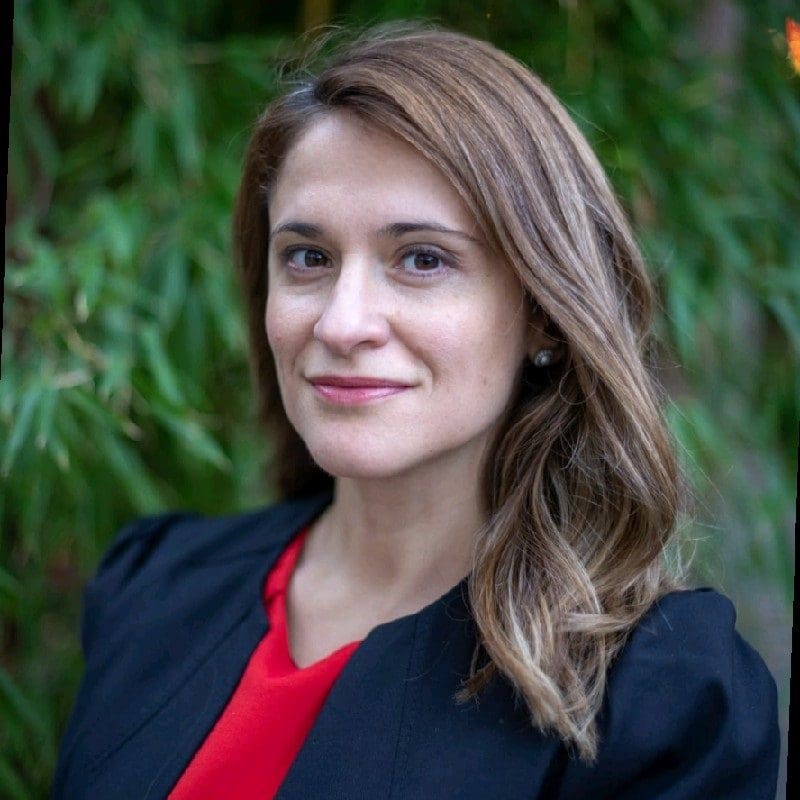
Normally, we wouldn’t include individual speeches within a keynote, but Biljana Kaitović’s incredible speech on the future of energy was something we had to mention.

After Selipsky’s opening speech Kaitović, Engie’s Group Executive Vice President in charge of IT and Digital, took to the podium and said “everything we do, we do with energy.” It was the lead into an incredible speech about what could be the single greatest crisis of our age: access to energy.

Biljana outlined how in 1882 Nikola Tesla came up with the idea of the alternating current motor. And how, that same year, the world’s energy consumption was about 9000 terawatt hours (about a third of what the US alone consumes today). Fast forward to today, and Kaitović highlights how global annual energy consumption is now 20 times higher. At 180,000 terawatt hours, this is enough power to keep Las Vegas in energy for a staggering 5,000 years.

Kaitović highlighted the need for energy to become affordable, accessible, secure, and—most importantly—green. She discussed the impact of fossil fuels, including “severe weather events [such as] forest fires, floods, droughts across geographies” and warned that there is little time left to deal with the climate crisis.

Kaitović went on to outline how data and digital could play a key role in the transition to renewable energy, in two important ways:

Optimizing and forecasting production levels of renewables

Most renewable energies are intermittent (the Sun does not always shine and the wind does not always blow). Optimizing and forecasting production levels for renewables would require a lot of data and advanced analytics. Here, predictive analytics, machine learning, and of course, the Internet of Things (IoT) are crucial.

Managing decentralized energy

As we move towards renewables, there will be an increase in small, local energy producers and consumers within “microgrids” (think of the houses with solar panels on the roofs or electric cars using their batteries to store energy). Balancing supply and demand in this complex system will require a real-time energy management system. Blockchain, for example, could be used to track sources and usages of energy.

#3 The importance of low cost, high performance, and security

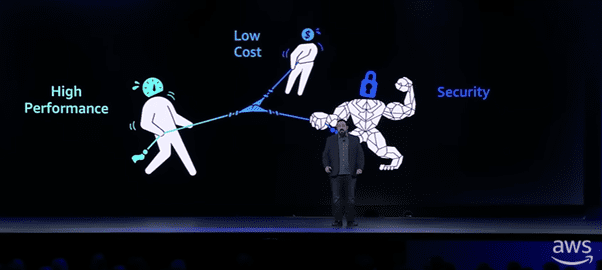
As a giant in all things security in the cloud, it was incredibly insightful to hear Peter DeSantis, Senior Vice President of AWS Utility Computing, discuss the constant “tug of war” between low cost, high performance, and security.

DeSantis outlined how, like with all innovations, delivering great performance creates tension. And that, with cloud computing systems, there is a need to find a balance between security and cost in the search for fantastic performance. He discusses how these two things are always in tension, and that correctly balancing the two will result in the best performance that is possible through the cloud.

The tension between high performance, low cost, and great security, as represented by Peter DeSantis

So, how do we improve performance, while also improving security and lowering costs? DeSantis’ answer is Nitro!

Throughout the remainder of his speech, DeSantis provided updates on the Graviton line of chips, the AWS Nitro system (and the launch of – AWS Nitro v5, C7gn EC2 instances, Graviton3E HPC7g EC2 instance, and more), also outlining developments in machine learning infrastructure and serverless computing.

An incredible speech that perfectly encapsulates (and provides solutions for) the tensions between low cost, security, and performance when building on the cloud, available to watch on the Amazon re:Invent website.

#4 How to transform data into meaningful insights

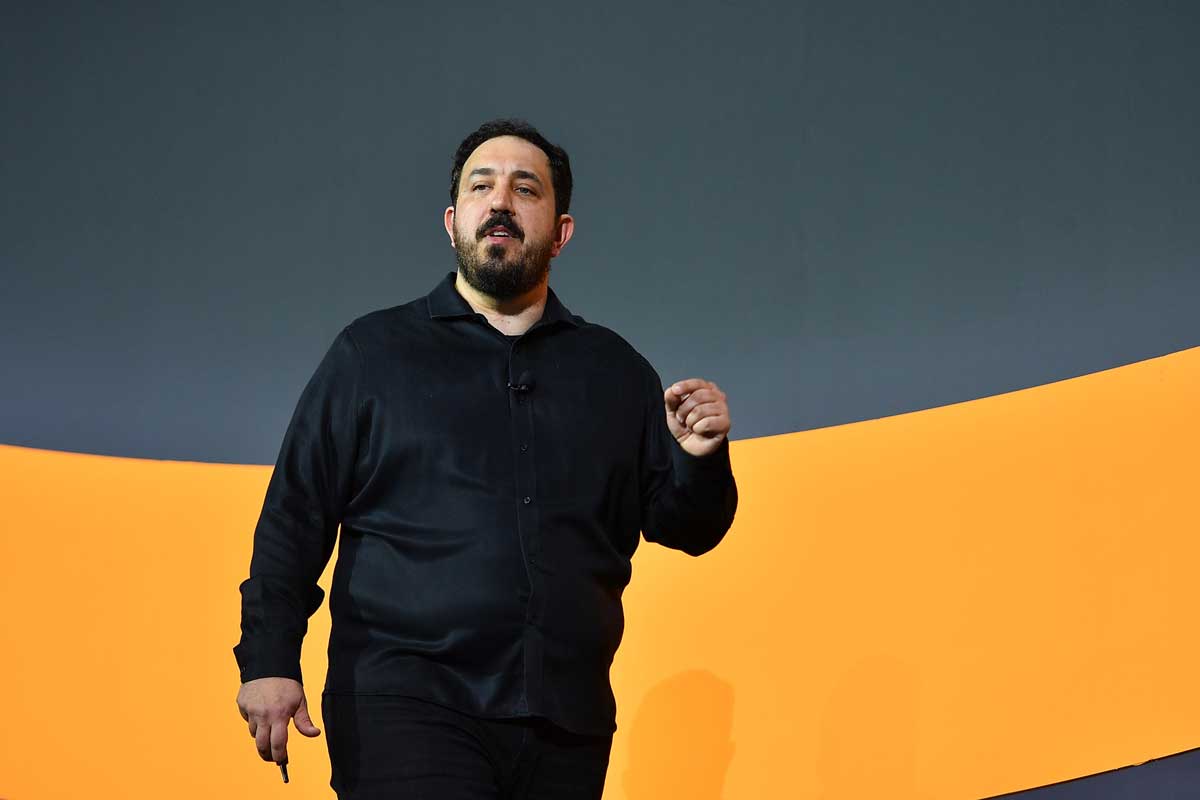
In this keynote, Vice President of Data and Machine Learning at AWS, Swami Sivasubramanian outlined some of the latest innovations from AWS that are helping businesses around the world to take their data and turn it into meaningful and actionable insights.

The talk features several incredible speakers, such as Rathi Murthy, Expedia Group CTO and President of Expedia Product & Technology, Kumar Chellapila, Shikha Verma, Head of Product at Amazon DataZone, and Anna Berg Åsberg, Global VP, R&D IT at AstraZeneca. The speakers took the time to discuss the various ways we can future-proof our data strategy as a sector, and how to “empower your organization to drive the next wave of modern invention with data.”

The keynote also featured the launch of several notable new tools and solutions, including:

  • The launch of Amazon Athena for Apache Spark, Amazon DocumentDB Elastic Clusters, Amazon SageMaker Geospatial ML capabilities, Amazon Redshift Multi-AZ, Trusted Language Extensions for PostgreSQL
  • Redshift innovations including Centralized Access Controls for Redshift Data Sharing, Redshift auto-copy from S3, and Amazon Appflow now offering 50+ Connectors
  • Educator training for AWS Machine Learning University

Revolent at AWS re:Invent

As ever, we were at this year’s AWS re:Invent. And what a week it was! Our team had a fantastic time in Las Vegas, with some incredible conversations with Partners, end-users, and, of course, catching up with our clients.

As a workforce development partner and an AWS Partner Network Select Training Provider, we pride ourselves on helping our clients and partners access the best delivery-ready AWS talent on the market. We do this in two ways:

  1. We cross-train experienced tech professionals into AWS and place them at our clients’ organizations as delivery-ready, billable talent
  2. We ReSkill existing employees with more advanced AWS certifications and technical expertise, to help our clients’ businesses flexibly plug AWS skills gaps

Interested in ReSkilling your existing employees, or want to access delivery-ready AWS talent?

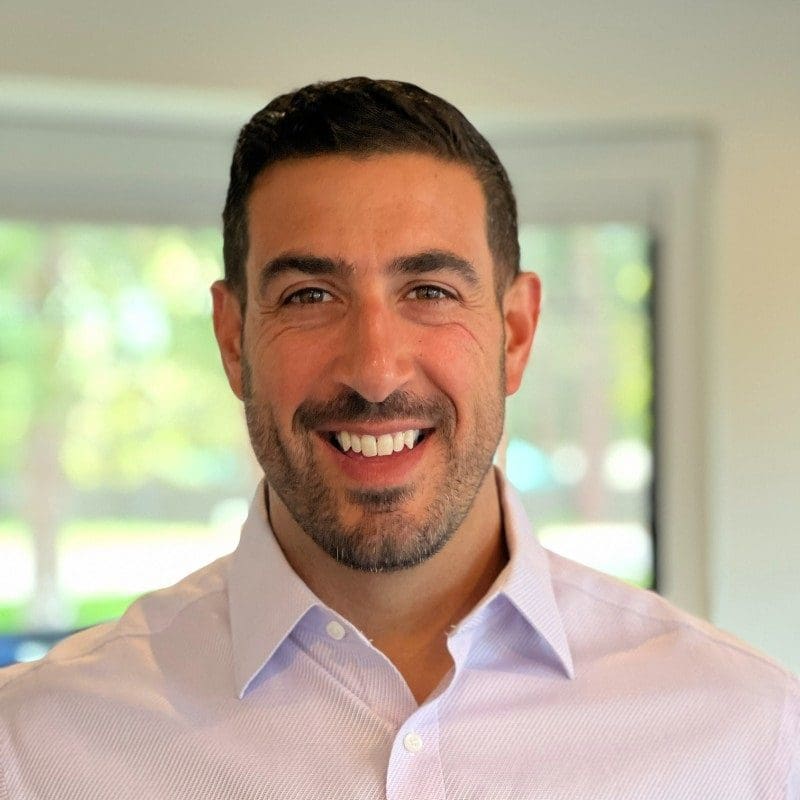
As for our week at AWS re:Invent? Our Chief Revenue Officer, Claude Sammoury, sums it up perfectly.

Ready to to partner with us and access delivery-ready AWS talent?

LinkedIn
Twitter
Facebook
Pinterest
Email